Overview
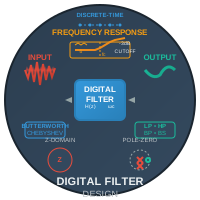
This project implements fundamental digital filter design algorithms with a focus on Butterworth and Chebyshev filter types. The work demonstrates deep understanding of filter theory, frequency response analysis, and practical implementation techniques for digital signal processing.
The implementation includes both theoretical analysis and practical code examples, making it a valuable resource for learning digital filter design principles and their applications.
Problem Statement
Digital signal processing applications often require filtering to remove noise, extract specific frequency components, or modify signal characteristics. The challenges include:
- Understanding filter design theory and mathematical foundations
- Implementing efficient filter algorithms with optimal performance
- Balancing filter characteristics (ripple, roll-off, phase response)
- Optimizing computational complexity for real-time applications
- Validating filter performance through analysis and testing
Solution
Butterworth Filters
Implemented maximally flat magnitude response filters with smooth frequency characteristics.
Chebyshev Filters
Developed equiripple filters with optimized roll-off characteristics and controlled ripple.
Analysis Tools
Created comprehensive analysis and visualization tools for filter performance evaluation.
Technical Implementation
Filter Design Algorithms
- Butterworth Design: Bilinear transformation and pole-zero placement
- Chebyshev Design: Chebyshev polynomial approximation and ripple optimization
- Filter Types: Low-pass, high-pass, band-pass, and band-stop implementations
- Order Calculation: Automatic filter order determination based on specifications
Implementation Features
- Transfer Function: S-domain to Z-domain transformation
- Frequency Response: Magnitude and phase response calculation
- Filter Coefficients: IIR filter coefficient generation
- Stability Analysis: Pole-zero analysis and stability verification
Analysis Capabilities
- Frequency Domain: Bode plots and frequency response analysis
- Time Domain: Impulse and step response analysis
- Performance Metrics: Cutoff frequency, ripple, and roll-off measurement
- Comparison Tools: Side-by-side filter performance comparison
Results & Impact
The project successfully implemented robust digital filter design algorithms with the following achievements:
- Accurate implementation of Butterworth and Chebyshev filter algorithms
- Comprehensive analysis tools for filter performance evaluation
- Efficient computational algorithms suitable for real-time applications
- Clear documentation and examples for educational purposes
- Validation against theoretical filter design principles
- Practical applications in signal processing and communications
This work demonstrates strong mathematical foundations and practical implementation skills in digital signal processing.
Lessons Learned
- Mathematical Foundations: Importance of understanding filter theory and mathematical principles
- Numerical Methods: Challenges in implementing stable numerical algorithms
- Performance Optimization: Balancing accuracy with computational efficiency
- Validation Techniques: Importance of thorough testing and validation
- Practical Applications: Understanding real-world constraints and requirements
- Documentation: Clear documentation essential for educational and reference purposes